
FLIGHT FRIGHT: Britain's 250 most aviation-blighted postcodes named and shamed
New data ranks every postcode district in the UK by aircraft noise
Britain's noisiest postcodes have been named and shamed in a new study that ranks every postcode district in England, Scotland, and Wales by aircraft noise — revealing that more than a quarter of a million households live in areas scoring in the most severe category. And experts warn it could soon get much worse.
The research, published today by My Flight Path, comes as UK airports handled a record 302 million passenger journeys in 2025 and as proposed expansion plans at Heathrow, Gatwick, Luton, Stansted and a string of regional airports could add a staggering 600,000 more flights to UK skies every year, increasing total aircraft movements from 2.7 million to 3.3 million annually — a 22% rise.
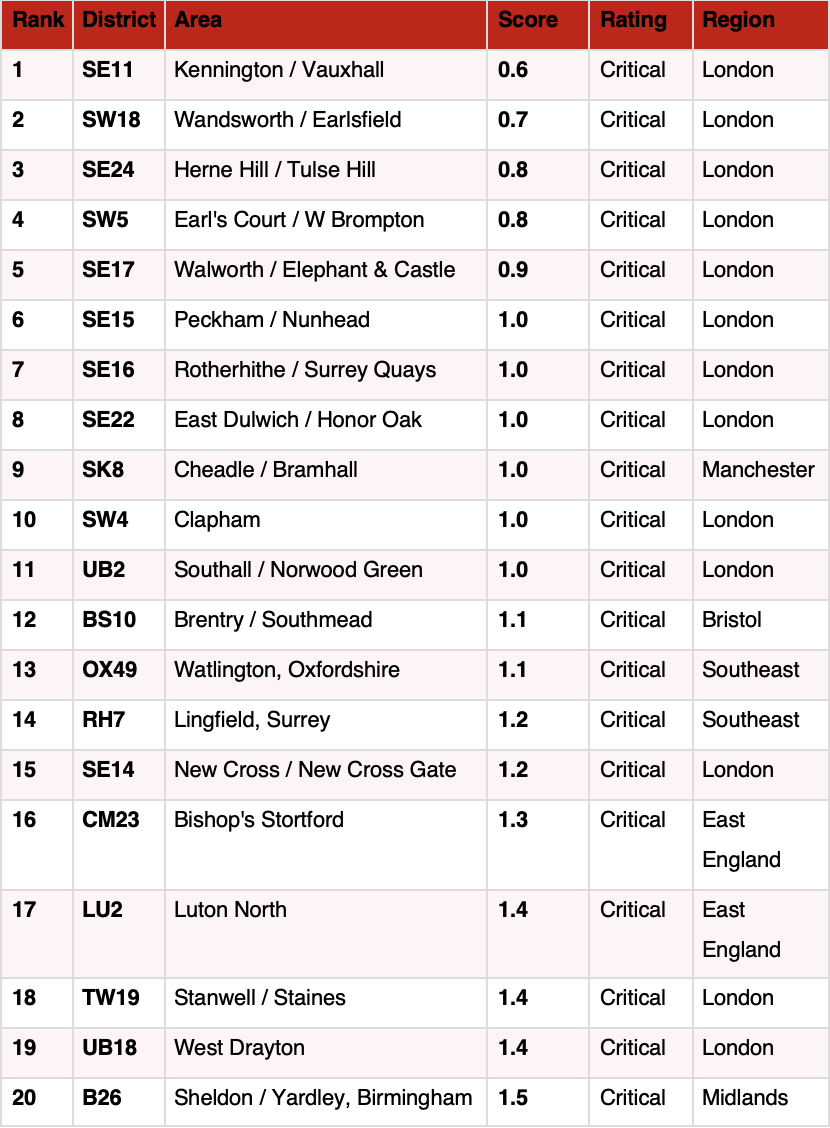
Kennington in South London emerged as the single worst-affected district in Britain, scoring just 0.6 out of 100. Eight of the ten worst districts are in London. But the problem stretches far beyond the capital - the Manchester Airport corridor dominates the North, Bristol and Edinburgh both feature, and even rural areas of Oxfordshire, Surrey and Essex make the list.
Jono Oates, Co-Founder at My Flight Path said, “With UK airports on course to handle hundreds of thousands more flights per year, the communities at the bottom of our rankings face the prospect of conditions deteriorating significantly. What’s already the worst aircraft noise in Britain could get meaningfully worse.
“The record passenger numbers we saw in 2025 are not a blip - they reflect the structural growth of aviation. That growth has a geography and the people living beneath it deserve to know what they’re dealing with and what’s likely coming.
“If you are unsure of the Flight Blight affecting where you live or above a property you are thinking of buying, we recommend a first step is to use our free postcode checker on our website.”
All 250 worst-scoring districts in Britain have received a Critical My Flight Path Flight Blight Rating - the most severe category. Every single one scores 17 or below out of 100. The national median score is 61.
The 20 worst-affected postcode districts in Britain
The hidden health threat
The issue is not simply one of noise irritation. Significant evidence links chronic aircraft noise exposure to serious health consequences. One recently published study found that significant noise increases - of the kind experienced in communities beneath busy flight paths - were associated with a 12.4% increase in stroke incidence, even after accounting for air pollution. The World Health Organisation has ranked environmental noise, with aviation prominent among its sources, as one of the top public health risks after air quality.
Researchers have established that aircraft noise uniquely fragments sleep cycles, triggering hormonal stress responses and sustained cardiovascular strain. For the communities at the top of our rankings - Kennington, Peckham, Wandsworth, Southall - this is not a theoretical concern. It is a nightly reality.
600,000 more flights: who stands to lose most?
Following government approval of Heathrow's £49 billion third runway expansion and with Gatwick, Luton, Stansted, and a string of regional airports finalising their own expansion plans, the UK's total annual flight movements could rise from 2.7 million to 3.3 million. Research by My Flight Path estimates that a realistic 6–10 dB noise increase in new flight corridors would result in 3-6% property value erosion for affected homes, on top of the underperformance already documented in current blight areas.
The communities already at the bottom of our rankings face a compounding risk: conditions that are already the worst in Britain could deteriorate further.
Record passengers and a property market waking up to the risk
UK airports handled 302 million passenger journeys in 2025 - the highest figure ever recorded, up 2% on the previous year. Regional airports saw particularly strong growth: Edinburgh up 8%, Liverpool up 11%, Newcastle up 7%.
The record numbers are focusing attention on aviation data as a material factor in property decisions. Research indicates that significant aircraft noise can reduce property values by 10–25%, yet flight path exposure has traditionally been excluded from standard property assessments.
Check your postcode
My Flight Path’s free Flight Blight Checker is now used by homebuyers, sellers, estate agents, and conveyancers to assess noise risk before committing. This gives an instant score for any UK postcode. Individual Flight Blight Reports are also available, providing a detailed breakdown of monthly flight counts, aircraft types, peak periods, and decibel estimates for any address.