

Airport expansion set to give lift-off to 600,000 more flights - creating new risks and opportunities for the UK property industry
Government has today green-lit Heathrow’s £49 billion third runway scheme
Airports across the UK are planning major increases in flight activity, pushing total aircraft movements up by around 22% compared with current levels.
New analysis from My Flight Path calculates house prices fall by approximately 0.5 - 0.6% for every decibel of aircraft noise
Following today’s Government backing of Heathrow Airport’s £49 billion third-runway plan, the country is now heading toward a surge of aviation capacity that will reshape the lived environment of millions of households and present both risks and opportunities for the property sector.
Heathrow’s expansion, combined with major growth programmes at Gatwick, London Luton, London Stansted and Farnborough airports, already accounts for over 500,000 additional flights per year. With regional airports, including Bristol, Southampton, London City, Manston and Leeds Bradford expected to finalise their own expansion plans shortly, total uplift could reach 600,000 more aircraft movements annually.
That would take the UK from approximately 2.7 million flights per year today to around 3.3 million - a 22% increase and the equivalent of almost 9,000 flights every single day.
Flight Blight: the new environmental pressure
Property due-diligence has historically focused on terrestrial risks: flood zones, structural condition, title, radon exposure, local planning and environmental constraints. Yet as airport expansion accelerates, airspace exposure - flight frequency, seasonality, aircraft type, altitude and night-time operations – has now become a material factor in valuation, resale liquidity and borrower confidence.
“The scale of aircraft-movement growth now underway in the UK means property due-diligence must include airspace intelligence and can no longer be treated as background noise,” said Jono Oates, Founder of My Flight Path.
“Our easy to integrate analysis helps surveyors, lenders and investors understand aviation exposure before it destroys value - but it also creates a powerful opportunity.
“Professionals who incorporate airspace intelligence can differentiate, protect their clients, and lead the market as this new environmental factor becomes impossible to ignore.”
The misconception that aviation impact is limited to airport-adjacent neighbourhoods overlooks the true risk: noise corridors can extend for miles, and the resulting effects are cumulative - impacting health, social wellbeing and the economic performance of local housing markets.
Impact on Property Values
Aircraft noise is not merely an annoyance - it is an economic force.
New analysis by My Flight Path of multiple international models estimates that house prices fall by approximately 0.5 - 0.6% for every 1 decibel of aircraft noise.
Therefore, a 6-10 dB increase, a realistic outcome under new flight corridors, equates to 3 - 6% value erosion for affected properties. That is enough to distort sales cycles, affect mortgage security and undermine investor confidence.
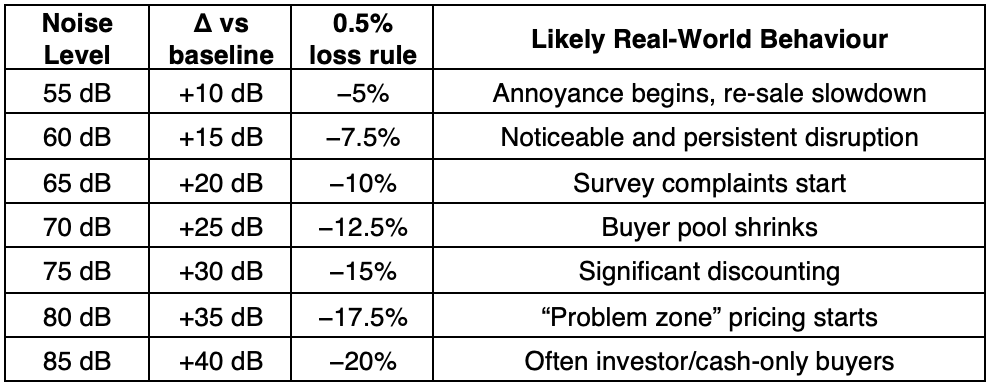
Noise Level Sensitivity and Market Response
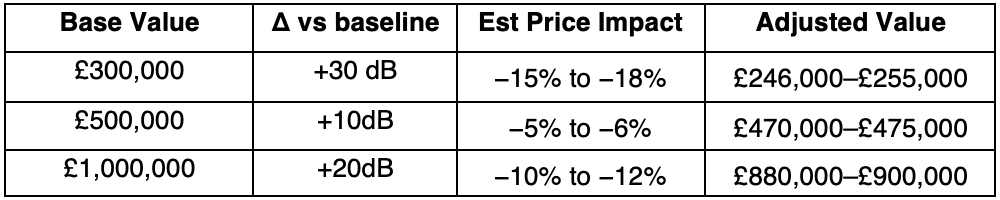
Value Depreciation by Noise Intensity at Typical Price Bands
The Opportunity: How My Flight Path Benefits the Property Industry
Aviation exposure is no longer an invisible risk. With the right intelligence, it can be measured, managed and turned into competitive advantage. My Flight Path provides the data needed to make that possible.
For surveyors, it adds a clear layer of environmental insight to reports, helping buyers understand aviation impact and reducing post-sale complaints. By evidencing risk rather than relying on judgement, surveyors strengthen their duty of care and professional indemnity position.
For lenders, the platform identifies collateral impairment before underwriting. Homes affected by flight corridors often suffer lower liquidity and higher buyer regret. Integrating the Flight Blight Rating supports ESG transparency and protects portfolio health in areas where noise patterns are shifting.
For developers and land promoters, My Flight Path helps screen sites at the earliest stage. It prevents investment into noise-sensitive locations, contributes to more accurate exit value forecasts and supports planning submissions when challenged by residents or councils. In a market increasingly shaped by environmental due diligence, aviation awareness is fast becoming a differentiator rather than a niche concern.
About My Flight Path
My Flight Path is the first service to give the real estate industry and house buyers around the world a comprehensive overview of the aircraft activity above specific properties and help avoid ‘flight blight’.
The company, based in Cambridge, UK, produces a Flight Blight Rating - a simple 0–100 score powered by a proprietary algorithm that processes over 100 million aviation datapoints, and benchmarks against 190 million properties worldwide.
The system identifies a property’s location, analyses the number of flights within a two-mile radius over the past year, and evaluates their altitude, aircraft type and noise characteristics to generate a concise exposure rating.
The company also produces Flight Blight Reports which give a clear summary of the data behind the Flight Blight Rating. For each property, it shows how many aircraft flew overhead in the past 12 months, with details by day and time. It also identifies types of aircraft, like commercial, leisure, business jets, military, and others, plus an estimated noise level on the ground.
The service is now being integrated by:
· Residential surveyors
· Mortgage lenders
· Developers
· Planning and environmental consultancies
· High-net-worth buyers