
Government New Towns Programme: 250,000 Homes Face 'Flight Blight’
Exclusive analysis reveals 11 of 12 proposed sites experience ‘severe’ levels of aircraft noise
Disturbance linked to sleep disruption, health risks, and £10-12 billion in property value loss
My Flight Path, the UK's leading aviation impact analysis service, has found that 11 of the 12 locations recommended by the Government's New Towns Taskforce will be significantly affected by aircraft noise, exposing future residents to noise levels proven to disrupt sleep, increase cardiovascular stress, and slash their property values by up to 26%.
The results reveal a failure to consider the impact of aircraft noise in site selection and show that 250,000 planned homes will sit beneath active flight corridors, with many set to see a mix of large commercial planes, private jets, military and general aviation aircraft regularly flying overhead at low altitudes, from early in the morning until late at night.
My Flight Path provides detailed Flight Blight Reports used by property buyers, estate agents, surveyors and mortgage lenders to assess flight path exposure. Each report analyses millions of aviation data points on aircraft altitude, frequency, timing and noise levels over specific properties.
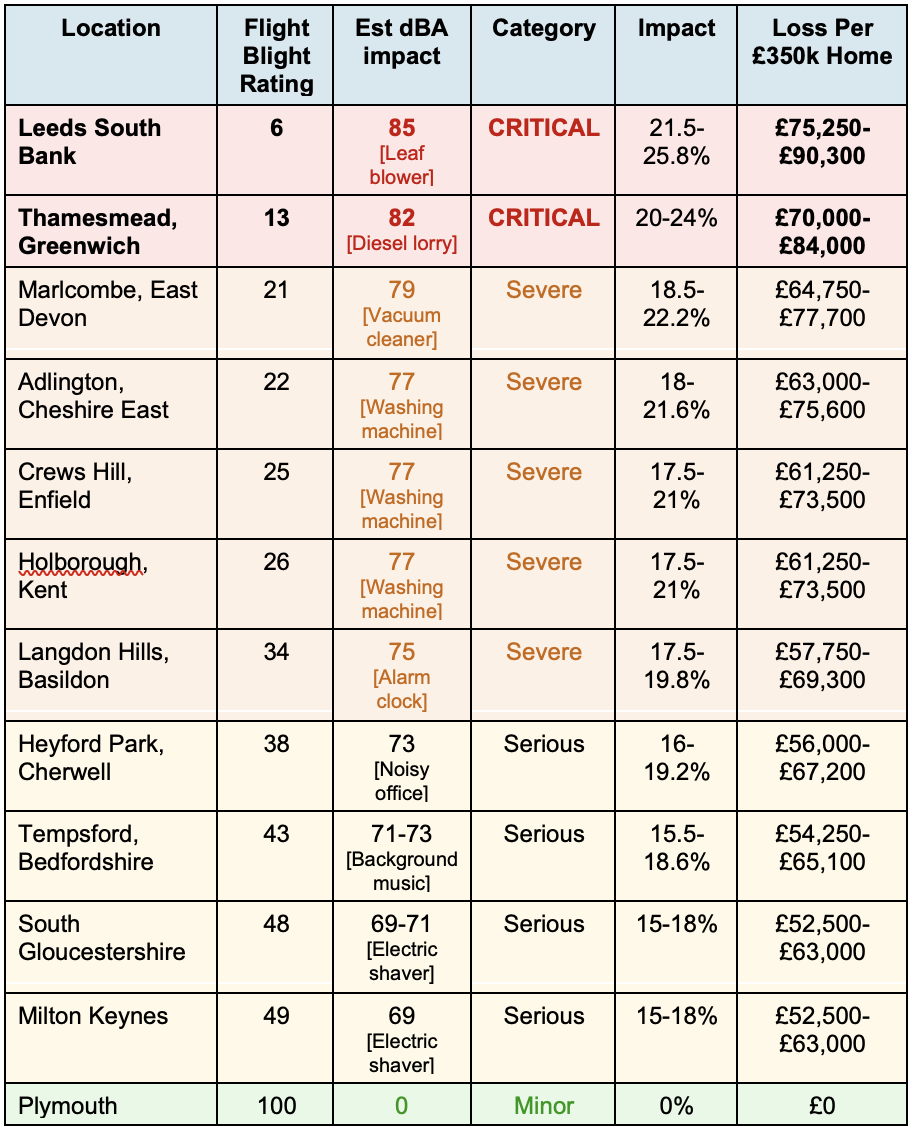
Complete assessment of all 12 New Town locations:
My Flight Path calculates a ‘Flight Blight Rating’ (0-100) for every UK property. Lower scores indicate greater aircraft exposure and impact.
Jono Oates, Co-Founder of My Flight Path, said: "While planners focus on transport links, schools, and ground infrastructure, aircraft noise exposure has received minimal attention.
“Eleven out of twelve locations face significant aircraft noise exposure. We're talking about building a quarter of a million homes where residents will experience sleep disruption, increased health risks, and property value loss - all because flight paths weren't properly considered.
"Unbelievably, some of these new sites sit on airport perimeters whilst others are many miles away, demonstrating that you don't need to live next to an airport to face severe aircraft noise exposure - flight paths extend for dozens of miles in every direction.
“The Government's Strategic Environmental Assessment must address this critical public health issue before final site decisions are made this spring. Alternative locations exist that would deliver the same economic benefits without condemning families to a lifetime under flight paths. This isn't nimbyism - it's evidence-based planning that puts public health first.”
Health impacts
International research has consistently demonstrated that aircraft noise exposure causes measurable health impacts. The World Health Organisation has stated that daytime noise levels above 55 dBA - significantly lower than the 76-85 dBA experienced at the worst-affected new town sites - increase risks of hypertension, cardiovascular disease, and sleep disturbance.
At Leeds South Bank and Thamesmead, where Flight Blight Scores indicate ‘critical’ exposure, residents will experience aircraft noise at 82-85 dBA - comparable to standing beside heavy traffic or using a leaf blower. At these levels, outdoor conversation becomes difficult, children's learning can be impaired and sleep disruption is virtually guaranteed during flight operations.
"The WHO guidelines are clear: aircraft noise above 45 dBA at night causes sleep disturbance," Oates explained. "At the sites we've analysed, residents will be exposed to levels far exceeding this threshold. We're not talking about occasional inconvenience - we're talking about documented health risks affecting hundreds of thousands of people."
The financial consequences
The health and quality of life impacts translate directly into property values. When homes cannot deliver peaceful living environments, the property market responds accordingly. My Flight Path research has shown that property values decrease by 0.5-0.6% for every decibel of aircraft noise above ambient levels of 40-45 dBA.
Based on planned housing numbers and typical new-build prices, My Flight Path estimates the total property value at risk across all affected New Town locations at £10-12 billion. This financial loss represents the market's recognition that aircraft noise exposure reduces quality of life and creates health risks that buyers will not pay full price to accept.
Estimated financial impact by location:
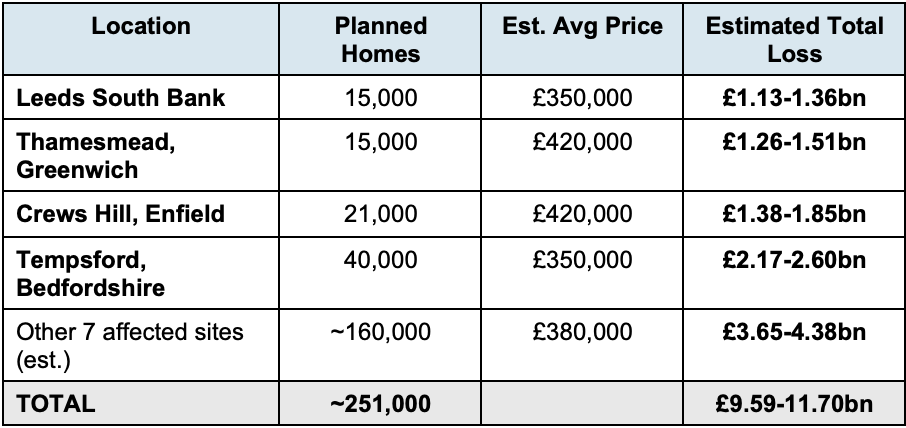
"These aren't theoretical losses," Oates explained, "Aircraft noise demonstrably harms health and disrupts daily life. Research shows prices fall by approximately 0.5-0.6% for every decibel of aircraft noise above ambient levels. When you apply that to a quarter of a million homes, you're looking at tens of billions in lost household wealth - the financial cost of building homes where residents face documented health risks and reduced quality of life."
Aviation growth
Last year’s Government backing for Heathrow’s £49 billion third runway signalled a major expansion in UK aviation capacity. Combined with growth at Gatwick, Luton, Stansted and Farnborough, and expected regional airport expansions, My Flight Path predicts that the UK could see around 600,000 more flights a year, rising from 2.7 to 3.3 million annually, almost 9,000 flights per day.
Aviation impact extends far beyond areas near airports: noise corridors stretch for miles, with cumulative effects on health, wellbeing and local housing markets. The need for clear flight path disclosure is urgent, especially as Government advice indicates homeowners newly affected by flight path changes are unlikely to receive compensation due to cost and complexity.
As the UK begins to roll out the largest airspace redesign in 70 years, many homes will face new or increased aircraft noise without financial recourse, making pre-purchase flight path analysis essential. Buyers who later fall under new routes risk property value losses without compensation, with long-term New Town developments particularly exposed over the coming decades.
Call for transparency
My Flight Path is calling for aircraft noise exposure to be disclosed in all major housing developments, particularly those in the New Towns Programme.
"This isn't about stopping development," said Oates. "It's about building in the right places and being honest with buyers. If you're spending half a million on a home - likely the biggest purchase of your life - you deserve to know whether aircraft overhead will disrupt your sleep, affect your health, and reduce your property value. Aircraft noise exposure should be disclosed upfront, just like flood risk, the building of a solar farm down the road or ground contamination."